

heat exchanger repair
Reducing Complexity: Why Standardising Heat Exchangers Lowers Costs and Improves Reliability
In many industrial operations, heat exchangers are critical assets. They support core processes across HVAC, food and beverage, chemical processing, power generation and manufacturing. In many cases, system performance, energy efficiency and product quality depend directly on their reliability. Yet despite their importance, heat exchanger systems are often far more complex than they need to be. Over time, the accumulation of custom designs, one-off specifications and inconsistent equipment choices can quietly drive up costs and introduce unnecessary operational risk.
Standardising heat exchangers is a reliable way to reduce complexity, lower lifecycle costs and improve system reliability. Rather than limiting flexibility, standardisation creates consistency, efficiency and predictability across the entire operation. When applied effectively, it allows organisations to maintain performance requirements while reducing variation and uncertainty.
The Hidden Cost of Complexity
Custom or highly varied heat exchanger designs can seem beneficial at first, particularly when optimising for a specific requirement or site constraint. However, as systems scale, age or are modified over time, complexity often becomes a liability rather than an advantage.
Common issues include:
-
Higher engineering and design costs for each new installation
-
Longer lead times due to bespoke manufacturing
-
Increased spare parts inventory and storage requirements
-
Greater maintenance effort and higher risk of incorrect part replacement
-
Reduced operational familiarity among technicians
These challenges compound over time, particularly for organisations operating multiple sites or large arrangements of heat exchangers. What begins as a tailored solution can evolve into a fragmented asset base that is costly to manage and difficult to standardise later.
How Standardisation Reduces Capital and Operating Costs
Standardised heat exchangers use consistent designs, materials and formats across applications where possible. This approach delivers cost savings at multiple stages of the asset lifecycle, from initial procurement through to long-term maintenance and replacement.
From a capital expenditure perspective, standard units benefit from economies of scale. Manufacturing costs are lower, procurement is simpler and lead times are more predictable. Engineering teams also spend less time redesigning equipment that already performs reliably in similar conditions, freeing up resources for higher value activities.
From an operational standpoint, maintenance costs are reduced through:
-
Fewer spare parts to stock and manage
-
Faster fault diagnosis due to familiar layouts
-
Shorter downtime when replacements are readily available
-
Simplified training for maintenance personnel
Over the life of the equipment, these savings often outweigh the benefits of custom designs, particularly in environments where uptime and operational continuity are critical.
Improved Reliability Through Proven Designs
Reliability is closely linked to repetition and experience. Standardised heat exchangers are typically based on designs that have been tested across multiple installations and operating environments, allowing performance characteristics and limitations to be well understood.
This results in:
-
Fewer unexpected failures
-
Reliable performance metrics under defined conditions
-
Improved confidence in thermal and pressure ratings
-
Easier identification of wear patterns and maintenance intervals
By contrast, one-off designs may introduce unknown risks that only become apparent after extended operation, increasing the likelihood of unplanned outages or premature equipment failure.

Faster Maintenance and Reduced Downtime
When equipment is standardised, maintenance becomes faster and more predictable. Technicians are already familiar with the unit layout, gasket types, plate patterns or tube arrangements. Documentation is consistent, and procedures do not need to be relearned for every system or site.
In industries where downtime is costly, this familiarity can significantly reduce mean time to repair. In many cases, spare heat exchangers or components can be swapped immediately rather than waiting for custom parts to be manufactured, helping operations return to service more quickly.
The impact of standardisation becomes clearer when comparing lifecycle utility, maintenance and downtime implications in a typical multi-unit installation. The example below illustrates the difference between a standardised five-unit 5 x 450 kW system and a customised configuration operating under similar load conditions over a three-year period.
Standard vs Customised Comparison Table
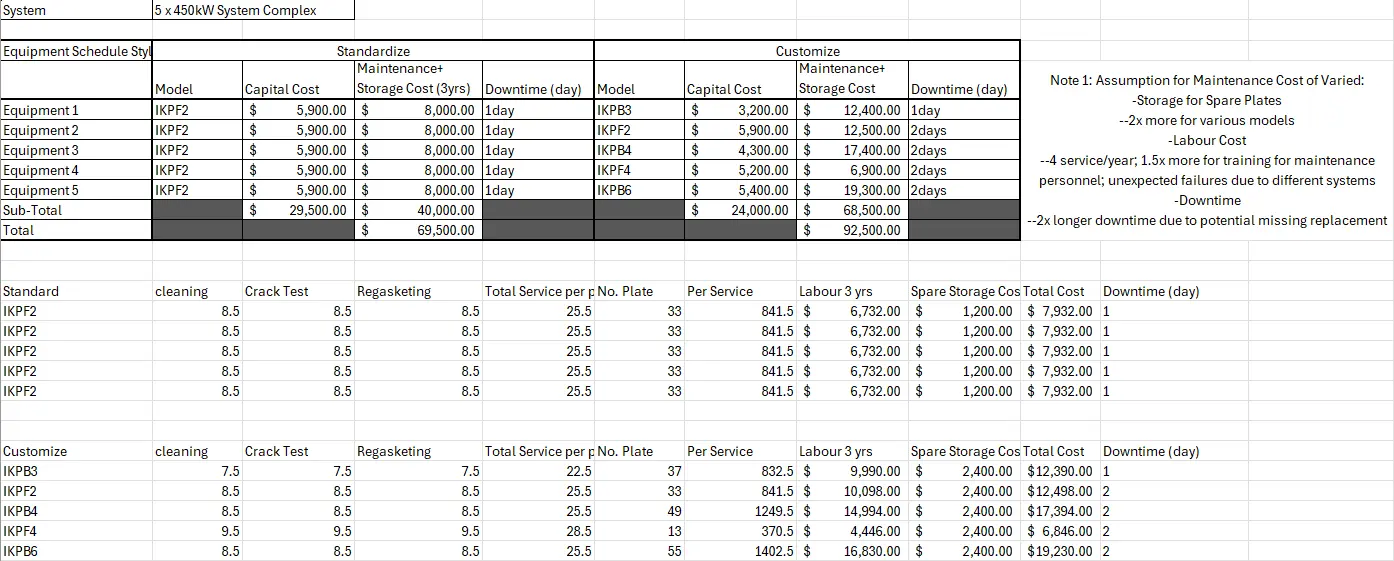
While the customised configuration shows slightly lower upfront utility costs in some cases, total maintenance and storage costs are significantly higher over three years. More importantly, downtime exposure increases due to model variation and limited parts interchangeability. The standardised configuration demonstrates lower overall lifecycle cost and reduced operational risk, primarily driven by spare part availability, training efficiency and faster service turnaround.
Supporting Scalability and Future Growth
Standardisation also supports long-term scalability. As operations expand, new systems can be integrated without reinventing specifications or retraining staff. Procurement teams can negotiate better supplier agreements, and asset management becomes more streamlined and transparent.
For organisations planning growth, mergers or multi-site operations, a standardised heat exchanger strategy creates a strong foundation for consistency, cost control and operational resilience.

When Customisation Still Makes Sense
Standardisation does not mean eliminating all custom solutions. Certain applications with extreme temperatures, aggressive media or strict space constraints may still require bespoke designs. The key is to limit customisation to where it genuinely adds value, while standardising the majority of applications wherever feasible.
A balanced approach often delivers the best outcome, combining the efficiency of standardisation with targeted customisation where it is truly justified.
The Economics of Heat Exchanger Repair: When Is Repair Better Than Replacement?
Heat exchangers are an essential part of modern industry. From chemical processing plants and food manufacturing lines to commercial HVAC systems, they play a critical role in thermal control, energy efficiency, and operational stability. When performance declines or leaks appear, the decision to repair or replace a heat exchanger quickly becomes an economic one, with consequences for capital expenditure, operating costs, energy use, and downtime risk.
As we move into 2026, the global heat exchanger market continues to grow rapidly, driven by decarbonisation targets, rising energy costs, and efficiency regulations. In this environment, choosing the wrong maintenance strategy can result not only in unnecessary spending, but also in long-term energy waste due to reduced thermal efficiency.
This article explores the economics behind heat exchanger repair versus replacement, focusing on lifecycle costs, efficiency impacts, risk, and practical decision thresholds used across industry.
Understanding Heat Exchanger Lifespans and Failures
Most industrial heat exchangers are designed for service lives of 15–25 years, depending on materials, operating pressures, temperatures, and maintenance practices. However, real-world conditions often shorten this lifespan.
Common degradation mechanisms include:
-
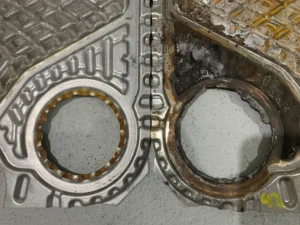
Corrosion and erosion of tubes or plates
-
Fouling and scaling that insulate heat transfer surfaces
-
Gasket ageing and loss of elasticity
-
Localised cracking or vibration damage
-
Shell thinning or distortion in shell-and-tube designs
Not all failures are equal. Some are localised and economically repairable, while others indicate systemic ageing that makes replacement the safer and more cost-effective option.
Looking Beyond Upfront Cost: Lifecycle Economics
The repair versus replacement decision should never be based on parts cost alone. Instead, it should be grounded in life cycle costing, which considers the total cost of ownership across the remaining life of the asset.
Lifecycle cost elements include:
-
Repair or replacement capital cost
-
Installation and commissioning
-
Energy efficiency and fuel consumption
-
Ongoing maintenance requirements
-
Downtime risk and lost production
-
Safety, compliance, and inspection costs
In many cases, energy consumption over time far outweighs the initial purchase price of the exchanger itself.
When Repair Makes Economic Sense
Repair is often the most economical choice when damage is localised.
Typical Repair Scenarios
Tube plugging or local tube/plate repair
In shell-and-tube/plate exchangers, if only a few tubes/plates are leaking or degraded, plugging or selective repair is usually a low-cost, fast solution. Turnaround times are often measured in days rather than weeks. However, if some tubes or plates are degraded, often more can follow.
Gasket replacement in plate heat exchangers
Plate-and-frame exchangers commonly experience gasket failure after 10–15 years. Replacing gaskets restores sealing integrity at a fraction of the cost of a new unit, provided the plates themselves are undamaged.
Chemical or mechanical cleaning
Fouling can reduce heat transfer efficiency by up to 30 percent. In many cases, a thorough clean delivers a return on investment within three to six months through reduced energy consumption alone.
Young equipment
If the exchanger is well below its expected design life and has a strong maintenance history, repair can extend service life significantly without introducing excessive risk.
When Replacement Becomes the Better Investment
Replacement is generally the economically superior option when repairs no longer address the root problem or when efficiency losses and risk outweigh short-term savings.
Replacement Conditions
Widespread corrosion or erosion
If a considerable amount of tubes/plates are compromised, the likelihood of cascading failures increases sharply, leading to repeated outages and escalating costs.
Shell integrity issues
Thinning, cracking, or distortion of the shell identified through ultrasonic testing is a major red flag. Shell repairs are complex, expensive, and often introduce safety concerns.
Design obsolescence
Older exchangers may not be compatible with higher efficiency flow arrangements or digital monitoring systems. New designs often deliver meaningful efficiency gains.
Chronic repair history
Frequent repairs are a strong indicator that the asset is approaching the end of its economic life, even if it remains technically operable.
The 50 Percent Rule
A common guideline is that if the total cost of repair including labour, parts, and downtime exceeds 50 percent of the cost of a new unit, replacement should be seriously considered.
While not absolute, this rule provides a practical benchmark for initial evaluation.
Delaying action is often the most expensive option of all. Fouling and degradation force pumps, boilers, and chillers to work harder to meet thermal demands, driving up energy use and accelerating wear elsewhere in the system.
In high-throughput industrial plants, these costs can escalate rapidly, often exceeding the price of proactive maintenance or planned replacement.
Downtime Risk and Operational Impact
Downtime is a critical economic factor, particularly in continuous or batch processing environments. An unexpected exchanger failure can halt production, disrupt downstream processes, and create safety risks.
Planned repairs or replacements allow:
-
Work to be scheduled during shutdowns
-
Spare units or bypass systems to be arranged
-
Labour and parts costs to be controlled
By contrast, emergency failures often result in premium labour rates, expedited parts, and significant lost revenue.
Technology and Predictive Maintenance in 2026
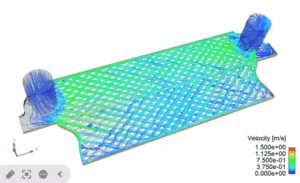
Modern heat exchanger management increasingly relies on predictive maintenance. Advances in condition monitoring, digital twins, and data analytics now allow operators to predict fouling rates, vibration issues, and corrosion progression before failure occurs.
By integrating inspection data such as eddy current testing, ultrasonic thickness measurements, and thermal performance trends, maintenance technicians can intervene to extend the heat exchanger’s lifespan.
This shift moves decision-making from reactive repairs to strategic asset management.
Making the Right Call
The economics of heat exchanger repair versus replacement ultimately come down to data, not intuition. Before deciding, organisations should:
-
Conduct non-destructive testing to understand true material condition
-
Quantify energy penalties associated with reduced heat transfer
-
Assess shell and structural integrity
-
Compare repair cost against remaining service life
-
Consider tube bundle replacement or re-tubing where appropriate, which can deliver many of the benefits of a new unit at a lower cost
In many cases, repair is the right choice. In others, replacement delivers better long-term value, lower risk, and improved efficiency. The key is understanding where each option sits within the full economic picture.